Our filters
Our filters
The system holds three filters in three standard 20" × 4.5" housings. One sediment and carbon composite, then two coconut-shell carbon blocks. All three are rated at 5 micron. A full set lasts 100,000 L of water, which is 12 to 18 months in most homes, and a change takes about ten minutes, with no plumber needed.
Performance figures are from Econova, the manufacturer.
- Stage 1Sediment and carbon compositeTraps sand, rust and silt, and starts on the chlorine. Protects the carbon blocks.
- Stage 2Coconut-shell carbon blockTakes out chlorine, taste and odour.
- Stage 3Second carbon blockA second pass for what's left, so it keeps up at full flow.
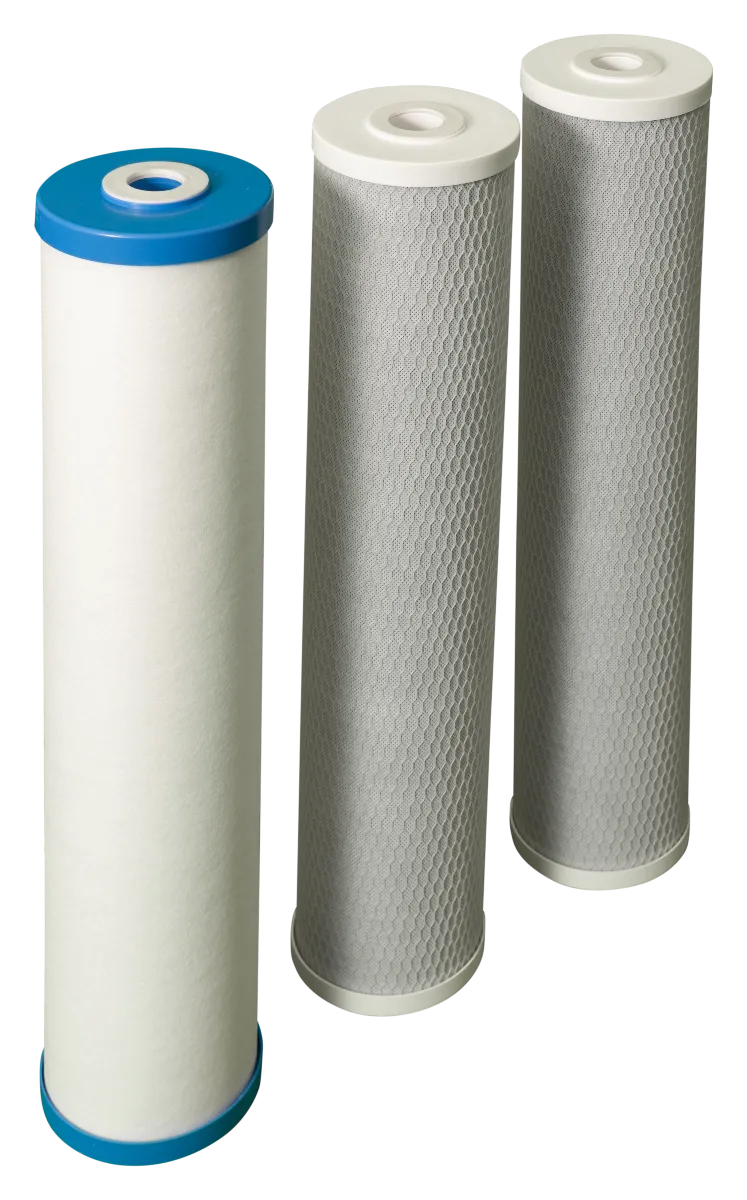
Your system comes with one set of filters. Looking for a refill?
Get in touch and we'll send you a genuine set of three, delivered Australia-wide.
Ask about refillsThe three filters
Stage 1
Sediment and carbon composite
ECON-PP20BB · 5 µm PP-CC
Traps sand, rust, silt and scale particles, starts chlorine reduction and protects the carbon blocks.
- Change
- Every 6 to 12 months
Stage 2
Coconut-shell carbon block
ECON-GAC20BB · 5 µm CTO
Dense coconut-shell activated carbon for chlorine, taste, odour and chemical reduction with extended contact time.
- Change
- Every 12 to 18 months
Stage 3
Second carbon block
ECON-GAC20BB · 5 µm CTO
A second carbon pass that captures remaining chlorine, taste and odour and sets the 5 µm nominal filtration.
- Change
- Every 12 to 18 months
Capacity and intervals
The set is rated for 100,000 L net water capacity. Stage 1 goes 6 to 12 months. Stages 2 and 3 go 12 to 18 months. Replace sooner if flow drops, the gauge gap widens or taste returns. The O-rings on the housings last 3 to 5 years and are checked at each change.
Carbon fills up long before it looks any different, so the carbon blocks go by the calendar, not by looks.
What the set reduces
Chlorine, chlorine taste and odour, sediment, rust and sand, VOCs, THMs, pesticides and herbicides.
How to read a filter's claims
This industry loves a big claim. The quickest way to check one is to look at what's actually in the three housings, and at what flow rate the numbers were measured.
Sediment filters catch the big stuff
Sand, rust, silt and dirt. That's why a sediment filter turns brown and clogs. It protects the filters after it, but does little for chlorine.
Carbon does the actual work
Chlorine taste and smell come out when water touches carbon. The more carbon the water passes through, and the longer it's in contact, the more chlorine comes out.
Be wary of fluoride claims
A whole-house filter can't take out all the fluoride. Fluoride media only work at slow flow, far below what a house uses. Ask what flow rate any fluoride figure was measured at. Ours doesn't remove fluoride, and we say so.
An honest example. The Atlas Filtri QA AL 20 BIG is an activated-alumina fluoride cartridge, and its seller publishes clearer specifications than most. The stated figure is 50% fluoride reduction at 1.5 L/min, under its test conditions. A shower alone can use up to 9 L/min, so even the best-documented fluoride cartridge isn't built for whole-house flow.
Why we stack two carbon blocks
A house doesn't run water at a trickle. A WELS 3-star shower uses up to 9 L/min, a 4-star tap 6 to 7.5 L/min, and older shower heads 15 L/min or more. Run a shower, a tap and the washing machine together and the filter sees 20 L/min or more. At that speed the water spends only seconds inside each filter.
A second carbon block doubles the carbon the water passes through, so more chlorine comes out at the flow rates a real house uses. That's why ours is a sediment and carbon composite, then two carbon blocks.
How we compare
Three popular three-stage whole-house systems sold online in Australia, against ours.
| Filter Boss | AquaCoPremium PFAS Three Stagewaterfilter.com.au | Filter Systems AustraliaHPF-3 triple, set up like oursfiltersystemsaustralia.com.au | |
|---|---|---|---|
| Price, inc GST | $2,500installed: filters, cover, frame and a standard installation included | $2,795with cover and frame | $2,093system, rear panel and a set of filters |
| What's in the housings | Sediment and carbon composite, then 2 carbon blocks | Sediment with scale inhibitor, 1 carbon, 1 fine-particle (Disruptor) | 5 µm poly spun sediment, then 2 coconut carbon blocks |
| Carbon blocks | 2 | 1 | 2 |
| Housings | 3 × 20" × 4.5" | 3 × 20" × 4.5" | 3 × 20" × 4.5" |
| Cover | Cover and frame included, in 4 colours | Stainless cover and frame (or bracket only) | Stainless enclosure, rear panel included above |
| Pressure gauges | 2 | 2 | 3 |
| WaterMark | WM-75284 | Not shown | Certificate 23247 |
| Warranty | Lifetime on frame, housings, gauges, connectors and coverwith genuine filters on schedule; otherwise 12 months | Retailers list 2 or 5 years | 12 months, parts only |
| Install | Standard installation by a licensed plumber included, in 15 areas; rural and regional quoted | Optional, in six capital cities | Installer directory |
From each seller's own product page, checked 8 November 2026. Their systems come in other configurations; we compared the one shown on that page, and set up the Filter Systems Australia HPF-3 the same way as ours: a sediment filter, then two carbon blocks. Prices change, so check before you buy.
What ECOPURE Dual CTO removes
Certified: the system's WaterMark certificate (WM-75284) verifies two performance claims under AS 3497: Category IV, taste and odour reduction, and Category V, chlorine reduction.
The table is Econova's own, wider list of stated reduction performance for the full set: the sediment and carbon composite, then two CTO coconut-shell carbon blocks.
| Contaminant or water quality issue | Reduction performance* |
|---|---|
| Chlorine | Up to 99% |
| Chlorine taste and odour | Up to 99% |
| Sediment (over 5 micron) | Up to 99% |
| Rust particles | Up to 99% |
| Sand and silt | Up to 99% |
| Turbidity | Up to 99% |
| VOCs (volatile organic compounds) | Up to 95% |
| Trihalomethanes (THMs) | Up to 95% |
| Pesticides | Up to 95% |
| Herbicides | Up to 95% |
| Benzene | Up to 95% |
| Toluene | Up to 95% |
| Xylene | Up to 95% |
| Ethylbenzene | Up to 95% |
| Carbon tetrachloride | Up to 95% |
| Chloroform | Up to 95% |
| Styrene | Up to 95% |
| Industrial solvents | Up to 95% |
| Phenols | Up to 95% |
| PFAS (where present) | Up to 90 to 95% |
| Lead (particulate form) | Up to 95% |
| Cysts (Giardia and Cryptosporidium)** | Up to 99% |
| Fine particles (over 1 micron) | Up to 99% |
| Unpleasant taste | Up to 99% |
| Unpleasant odours | Up to 99% |
* Econova's figures, shown as "up to". Actual performance varies with water quality, flow rate and filter condition. Independent lab results to be published.
** Econova's figure.
Replacement filters
Genuine Econova filters, sold as a set of three, with free delivery. Your system comes with its first set.
| Set | Change |
|---|---|
| Refill set of three PP20BB + 2 × GAC20BB | Stage 1 every 6 to 12 months, the carbon blocks every 12 to 18 |
Genuine or another brand?
The housings are standard 20" × 4.5", the size the industry calls Big Blue. The manufacturer says it plainly: no restrictive fittings, choose your own filter supplier. Any brand's 20" × 4.5" cartridge fits, and you can buy from anyone.
The other half is the warranty. The lifetime warranty on the frame, housings, gauges, connectors and cover only applies while genuine Econova filters are fitted on schedule. Fit another brand, or let a change slip, and the warranty is the standard 12 months from installation. Filters themselves are consumables and are not covered; O-rings and seals carry 12 months.
Full conditions are on the system page.
Will our set fit my housings?
We sell one set: three filters for 20" × 4.5" housings. If your system has three housings of that size, from any brand, the set fits. A cartridge of that size is about 508 mm long and about 114 mm across the end.
If your housings are a different size, shorter or narrower, our set won't fit and we don't sell one that does. Any plumbing supplier can match the size printed on your old cartridge.
The filter change
With a bypass loop and an isolation valve either side of the system, the house keeps its water while you change filters. No plumber is needed for a change. A standard 4.5-inch housing spanner from any plumbing supplier helps if a bowl is tight.
Close the isolation valves
One on the inlet side, one on the outlet side. The system is now off the line.
Open the bypass
Water goes around the system and the taps keep running while you work.
Press the pressure-relief buttons
On the head of each housing. This lets the pressure out so the bowls come off easily.
Unscrew the bowls
Unclip the cover and unscrew each bowl, by hand or with a housing spanner if it is tight. Have a bucket under them; they hold water.
Swap the filters
Old out, new in. Stage 1 is the sediment and carbon composite, stages 2 and 3 are the carbon blocks. Check the O-rings while the bowls are off.
Hand-tight
Screw each bowl back on by hand. Snug is enough. Never tighten them with a spanner.
Close the bypass
Water now has to go through the system again.
Open the isolation valves slowly
Inlet first, then outlet. Slowly, so the housings fill without a bang.
Bleed the air
Press the relief buttons again until water, not air, comes out. Check for drips, clip the cover on, and note the date and the two gauge readings.
Flush for 5 minutes
Run a cold tap for 5 minutes before drinking the water. Do the same whenever the system has sat unused for more than 14 days.